
Sentry Labs is helping ocean industries see what is happening beneath the surface
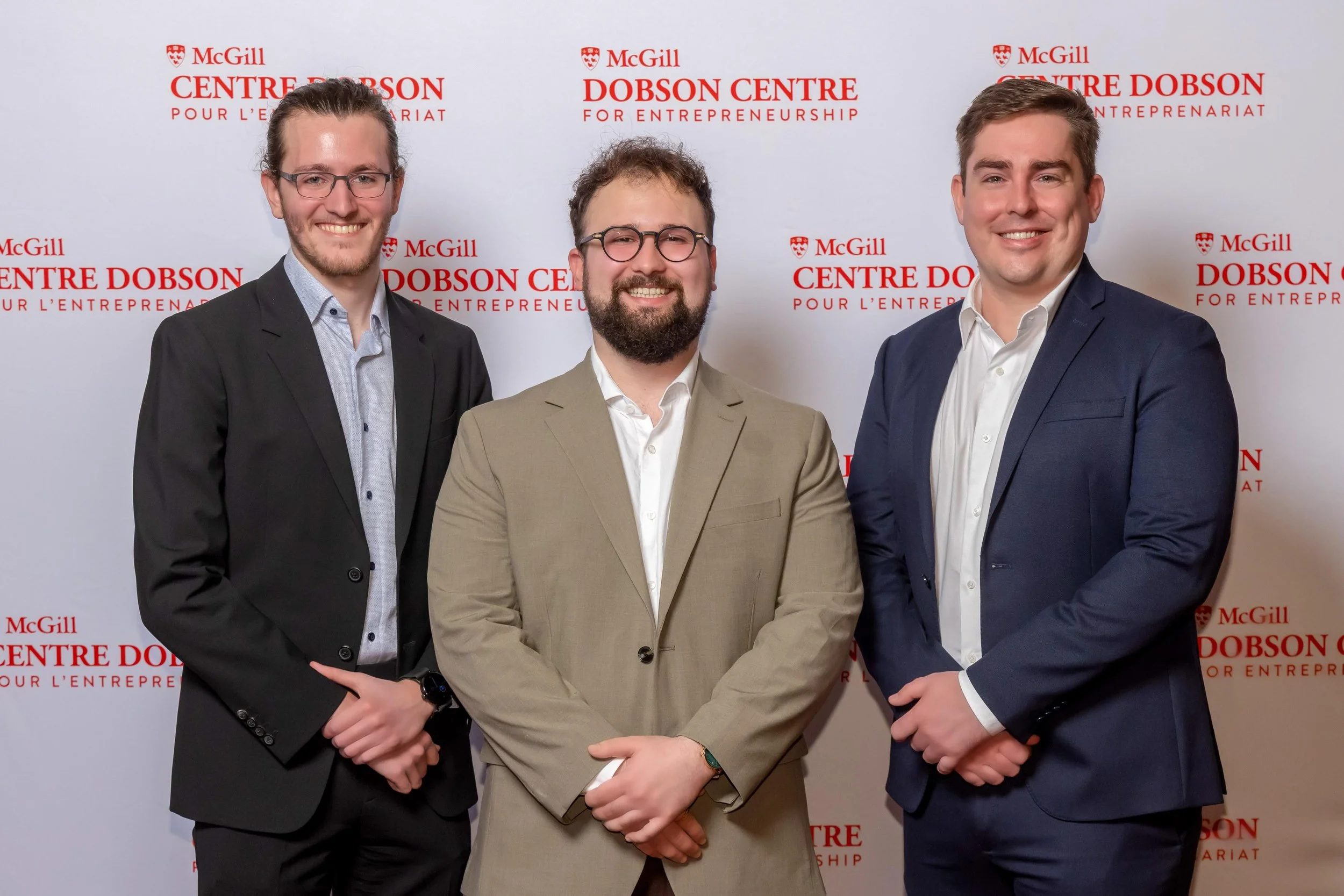
From left: Sentry Labs co-founders Martin Chaperot, Andrei Bogza and Ryan Borotra. Sentry Labs, a 2026 Ocean Idea Challenge company based in Montreal, Quebec, is developing graphene-based biosensing systems for real-time water monitoring, with an initial focus on helping aquaculture operators, researchers and environmental monitoring organizations detect harmful biological and chemical contaminants faster. Photo submitted.
For Ryan Borotra, the idea behind Sentry Labs began with a simple but powerful realization: even in places where the ocean shapes daily life, we still cannot always see what is changing beneath the surface until it is too late.
Borotra, co-founder and CEO of Sentry Labs, grew up in Saint-Pierre and Miquelon, where the ocean is woven into the culture, economy and rhythms of everyday life. Alongside co-founders Martin Chaperot and Andrei Bogza, that background has strongly shaped the company he is now building from Montreal, Quebec — and the problem they want to solve.
“One thing that has shaped my perspective is coming from a small island territory where the ocean is not abstract, it directly affects livelihoods, communities, and daily life,” Borotra said. “That background has strongly influenced the kinds of problems I am interested in working on and the long-term vision behind Sentry.”
Sentry Labs, a 2026 Ocean Idea Challenge company, is developing graphene-based biosensing systems for real-time water monitoring. Its goal is to enable faster, more accessible detection of harmful biological and chemical contaminants in aquatic environments, with an initial focus on aquaculture and environmental monitoring.
Today, many aquaculture operators, marine researchers and environmental organizations still rely on centralized, delayed and infrequent testing to monitor water quality, harmful algal blooms, pathogens and other contaminants. That lag can have major consequences. By the time results are available, a biological or chemical event may already be causing ecological damage, economic loss or operational disruption.
Sentry is working to change that by bringing molecular-level monitoring closer to where decisions are actually made.
“Sentry Labs is developing graphene-based biosensing systems for real-time water monitoring, enabling rapid detection of harmful biological and chemical contaminants,” Borotra said. “We are initially focused on supporting aquaculture and environmental monitoring through faster, more accessible sensing technologies.”
The company’s early focus is practical and urgent. Aquaculture operators need timely, reliable information to protect stock health and respond to changing water conditions. Researchers need better tools to understand dynamic aquatic systems. Environmental monitoring organizations need faster access to contaminant data to support healthier ecosystems and more informed decision-making.
Longer term, Borotra sees potential applications across coastal monitoring, fisheries, public agencies and other ocean sectors that depend on reliable molecular-level monitoring of aquatic environments.
“One of the biggest turning points came during conversations with researchers at IFREMER in my home territory of Saint-Pierre and Miquelon, who told us that when it comes to the ocean, we are still essentially blind at the molecular level,” Borotra said. “Despite how critical marine systems are, there is still a very limited ability to continuously monitor biological and chemical signals in real time, especially outside centralized labs.”
That insight became central to Sentry’s vision: a future where biological and chemical changes in aquatic environments can be detected continuously, rapidly and accessibly — before they escalate into larger problems.
When Sentry first connected with the Ocean Startup Project, the company was in early research and development, while also working to better understand which analyte panels and monitoring applications should be prioritized based on industry demand. Through the Ocean Idea Challenge, the team is continuing customer discovery and technical validation to define its first target applications, while building toward early prototype development, research and industry partnerships, and future pilot testing in real-world aquatic environments.
Borotra said the program is already helping Sentry clarify its path forward.
“We’ve only recently started the Ocean Idea Challenge, but OSP has already helped us build a much clearer plan for the next few months across product development, customer discovery, and fundraising,” he said. “Even before joining the program, different members of the OSP team were generous with their time, helping us better understand the Canadian ocean tech sector and connecting us with partners and ecosystem players that could support us throughout the journey.”
For Sentry, those early conversations matter. The company is proud of the relationships it has begun building with organizations and researchers working directly in the ocean and aquaculture sectors. Those discussions have helped validate that the problems Sentry is targeting are real, urgent and worth pursuing.
They have also reinforced one of Borotra’s core beliefs about building in the ocean sector: technology alone is not enough.
“A lot of ocean problems are highly interdisciplinary and deeply connected to real-world operations, regulation, infrastructure, and environmental variability,” he said. “Building an ocean startup is not just about developing technology, it also requires spending time with the people working on the water, understanding how decisions are actually made in the field, and building solutions that can realistically integrate into those environments.”
That field-level understanding is especially important for a company developing sensing technologies for complex, living environments. Aquatic systems are constantly changing. Conditions vary by site, season, species, operation and geography. For Sentry to succeed, its technology must not only be scientifically strong — it must also be practical, accessible and usable for the people who need the data most.
That is the opportunity Borotra sees within Canada’s ocean startup ecosystem. For him, building Sentry is not only about advancing a technology platform. It is about contributing to more resilient ocean industries and healthier aquatic environments.
“Growing up in Saint-Pierre and Miquelon, the ocean was always a major part of daily life, culture, and the local economy,” he said. “Being part of Canada’s ocean startup ecosystem feels meaningful to me because it creates an opportunity to contribute to sectors and environments that are deeply connected to where I come from, while working alongside people trying to build more sustainable and resilient ocean industries.”
As Sentry moves through the Ocean Idea Challenge, its next steps are focused on sharpening the problem, validating the technology and building the partnerships needed to test in real-world settings. The company is working toward early prototype development and future pilots that could help aquaculture operators, researchers and environmental organizations detect harmful changes sooner — and act with greater confidence.
For Borotra, the work requires resilience, persistence and a willingness to keep moving through uncertainty.
“You will constantly run into uncertainty, setbacks, and moments where things seem impossible, but continuing to move forward and adapt is often what separates the companies that survive from the ones that disappear,” he said.
Sentry’s journey is still early, but its ambition is clear: to help ocean industries move from delayed snapshots to real-time insight, and to give the people working in aquatic environments better tools to understand what is happening before the damage is done.
Learn more at sentrylabs.cc